Can We Define European Civilisation?
16 april 2026 | John Laughland

Can we define European civilisation ?
John Laughland
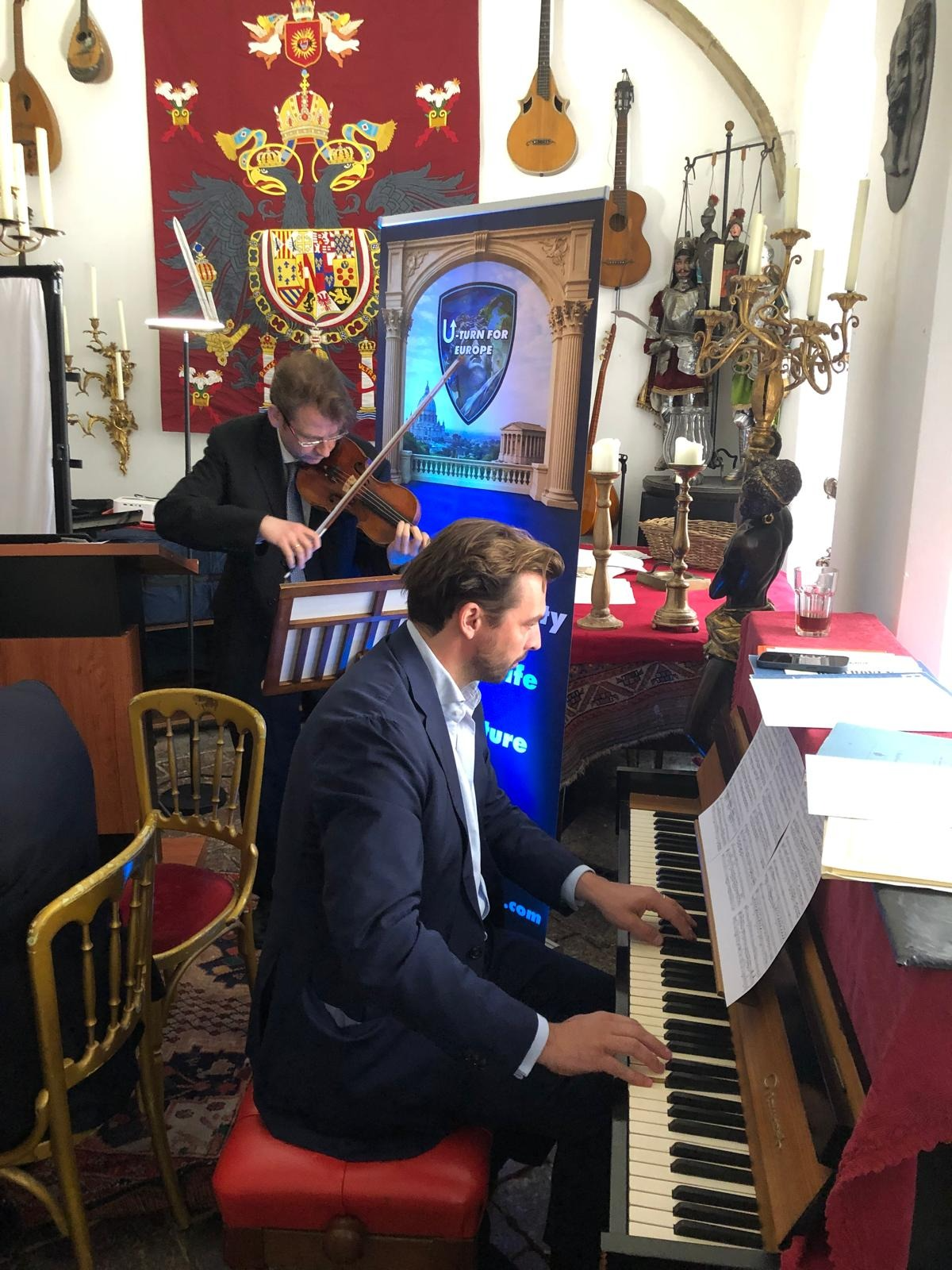
Lecture given at the U-Turn for Europe conference, Vienna, 11 April 2026
Many people have tried to define European civilisation, with varying degrees of success. In his great television series made in the late 1960s, the British art historian Kenneth Clark stood on the Pont des Arts in Paris, the Institut de France on one side of the river, the Louvre on the other, with Notre Dame upstream, and said, ‘What is civilisation? I don’t know. I can’t define it in abstract terms – yet. But I think I can recognise it when I see it.’ This is perhaps a rather pragmatic, British approach. The contemporary French historian, Rémi Brague, has no such inhibitions. For him, Europe is la Romanité, Roman-ness: to be European is to be a child of Rome, Rome being the synthesis of Athens, Jerusalem and Rome, all three of which, Brague claims, have a sense of an inherited civilisation which they wish to nurture and transmit to future generations. He uses the metaphor of the aqueduct to convey this idea.
I would like to build upon Brague’s argument to say that the distinctive feature of European civilisation lies in its conception of the state. The state in European civilisation is the link between ‘things divine and things human’, to quote what the Emperor Justinian said about justice in Book I of his Institutes. This is certainly not to make the state divine. It is instead to say that the state makes real the most important of all the values, justice. Virtues, indeed, including justice, are the very basis of statehood. In the opening lines of the Magna Moralia, Aristotle says that ethics is a subcategory of statehood because you cannot have a state without virtuous citizens. However, the relationship between the highest objective values and the state is two-way: the role of the state is also to promote those values. Aristotle says that politics is the highest of all the arts (Magna Moralia 1182b), the sum of all other associations (Politics Chapter 1), and that ‘the goal of politics is the good of man’ (Nicomachean Ethics, Book I, 1094a). ‘Political association has as its end the virtue and the happiness of individuals and not just life in common.’ (Nicomachean Ethics, Book III, 1281a); ‘and this is why justice is often considered to be the most perfect of all virtues, neither the evening nor the morning star are as admirable’ (NE 1129b). For Aristotle, the state is the association of beings who have a sense of good and evil, justice and injustice, which they enjoy as a result of being animals endowed with reason (Politics, Book 1). Man alone has this faculty. The state is prior to the family and the individual because ‘the individual, when isolated, is not self-sufficing.’ Justice is the bond of states (Politics 1253a). Without the state, man is a ferocious beast or a God. For His part, God is not an ‘imperative ruler’ (‘epitaktikos archon’, Eudemian Ethics 1249b line 14) but is the end with a view to which prudence (phronesis) issues its commands.
In other words, civilisation – which precisely means living in a city, life in the city (in the sense of ‘polis’) - is the means by which man uses his highest faculties to tend towards perfection, towards God. European civilisation is based on a concept of natural law, which it is the state’s role to emulate and to make real. This is, by the way, also the distinguishing feature of European art, which is more glorious than the art of any other civilisation. When we see a great painting or hear a great piece of music, its greatness lies precisely in the intimations of the transcendent which inspire it. European art tries to depict or evoke the divine, something which, for instance, Islamic art never does because any representation of the divine is strictly forbidden as blasphemous. Islamic art is just decoration. European civilisation is based on a particular intersection between the particular and the universal: the particular embodies the universal and the universal inheres in the particular.
If we contrast this approach with the Jewish and Islamic approaches, we will see the difference. The Jewish tradition to statehood is a very tenuous one; in fact, it is almost hostile. The ancient Israelites were initially tribes which appointed ‘judges’ to rule over them only when there were disputes between them, rather like Roman dictators. The history of the United Kingdom of Israel was very short, about a century, before it split. Those kings – Saul, David and Solomon – were more mystical figures than political ones. David wrote the Psalms, Solomon built the temple and issued his famous ‘judgement’. But that judgement was precisely not political but instead moral. Moreover, the execution of Christ was obtained by the Jews by specifically renouncing any claim to political sovereignty and instead instrumentalising their subjection in order to pursue a religious goal: ‘We have no other king but Caesar!’ (Gospel of St John, 19:16). After the destruction of Jerusalem, Judaism has continued to exist in every state in the world for two millennia without being incorporated in a state of its own: the recent state of Israel is not specifically religious and there are more Jews outside it than in it.
Islamic civilisation is almost exactly the opposite. It is precisely a political religion, in the sense that sharia law is a structure of rules for the whole of life. It would be entirely incompatible with Islam to leave secular life to human rules alone: the distinction between temporal and secular power simply does not exist. On the contrary, it is rejected as relegating God outside of human affairs. The original Arab conquests were just that – conquests, i.e. the establishment of political rule over new territories. In La Loi de Dieu Rémi Brague says that the oldest surviving document in the history of Islam is a tax receipt from an Egyptian to his new Arab overlord. Islam is therefore directly a form of political rule, as the concept of the ummah (the Islamic ‘nation’) expresses. The division of the world between dar al Islam and dar al-Harb (the land of peace, the land of war) is precisely political, there being no more eminently political division than the one between war and peace.
So whereas Judaism is eminently unpolitical and hostile to the state, Islam is the state. Whereas the divine in Islam cannot be represented, and whereas the name of God cannot be uttered by the Jews, Christian civilisation is based, like Greek and Roman, on the conviction that the divine can be shown and can show itself in human affairs. The distinction between spiritual and temporal power is not today’s separation between Church and State, a separation which has caused both Church and State to wither. On the contrary, the interpenetration of the secular and the divine invigorates both of them.
In 1940, as Europe was entering one of its darkest hours, Pope Pius XII began excavations under the high altar of St Peter’s basilica. The archaeologists discovered there an entire Roman necropolis – one of the many wonders of that wonderful city. Soon enough they located the Constantinian shrine built on the pilgrimage site where for centuries Christians had come to venerate St Peter’s tomb – he had been martyred in the Vatican stadium – and eventually the saint’s relics themselves. We should see in this extraordinary decision by Pope Pacelli, to dig down, quite literally, to the very foundations of our civilisation, a delightful metaphor and model for our own quest in today’s dark times as well.