Climate Alarmists Undermined by New Report from the International Panel on Climate Change
13 mei 2026 | Forum for Democracy Intl

In a newly published report by the Intergovernmental Panel on Climate Change (IPCC), earlier predictions about future global warming have been drastically revised downward. The most extreme climate scenario (4 to 6 degrees of warming by 2100), which for years stood at the centre of predictions about catastrophic warming, large-scale flooding and societal collapse, has now been dropped. Yet this very scenario formed the basis for policy decisions, sweeping climate measures and alarmist media coverage over the past years. Now that even the IPCC itself is distancing itself from these predictions, the question arises to what extent current climate policy can still be justified on the basis of such extreme, and now outdated, assumptions.
For years, public opinion has been subjected to alarmist doom scenarios in order to justify expensive and ineffective climate policies. Citizens have been forced to pay higher taxes, entrepreneurs burdened with increasingly strict regulations, and entire sectors placed under pressure because of predictions of catastrophic warming.
Now it appears from a new proposal for the IPCC’s so-called “CMIP7 programme” that the most extreme climate scenario from previous reports can no longer be regarded as realistic. This concerns the scenario in which greenhouse gas emissions continue to rise dramatically throughout this century (the so-called SSP5-8.5 scenario from CMIP6). The document states that these high emission levels and their credibility “have been questioned.” It also indicates that future high-emission scenarios are likely to be lower than this previous disaster scenario.
Earlier Doubts About the IPCC
That is remarkable. This precise scenario was used for years to spread visions of four to six degrees of warming, climate disasters, mass flooding and societal disruption. Media outlets, activist organisations and politicians consistently presented this extreme scenario as though it were a realistic picture of the future.
Forum for Democracy pointed out years ago that this scenario was in no way realistic. In interviews, articles and parliamentary contributions, we consistently argued that the 8.5 scenario was based on absurd assumptions, such as an explosive growth in coal use. Yet it was continually used to justify alarmist predictions.
The Hockey Stick Graph
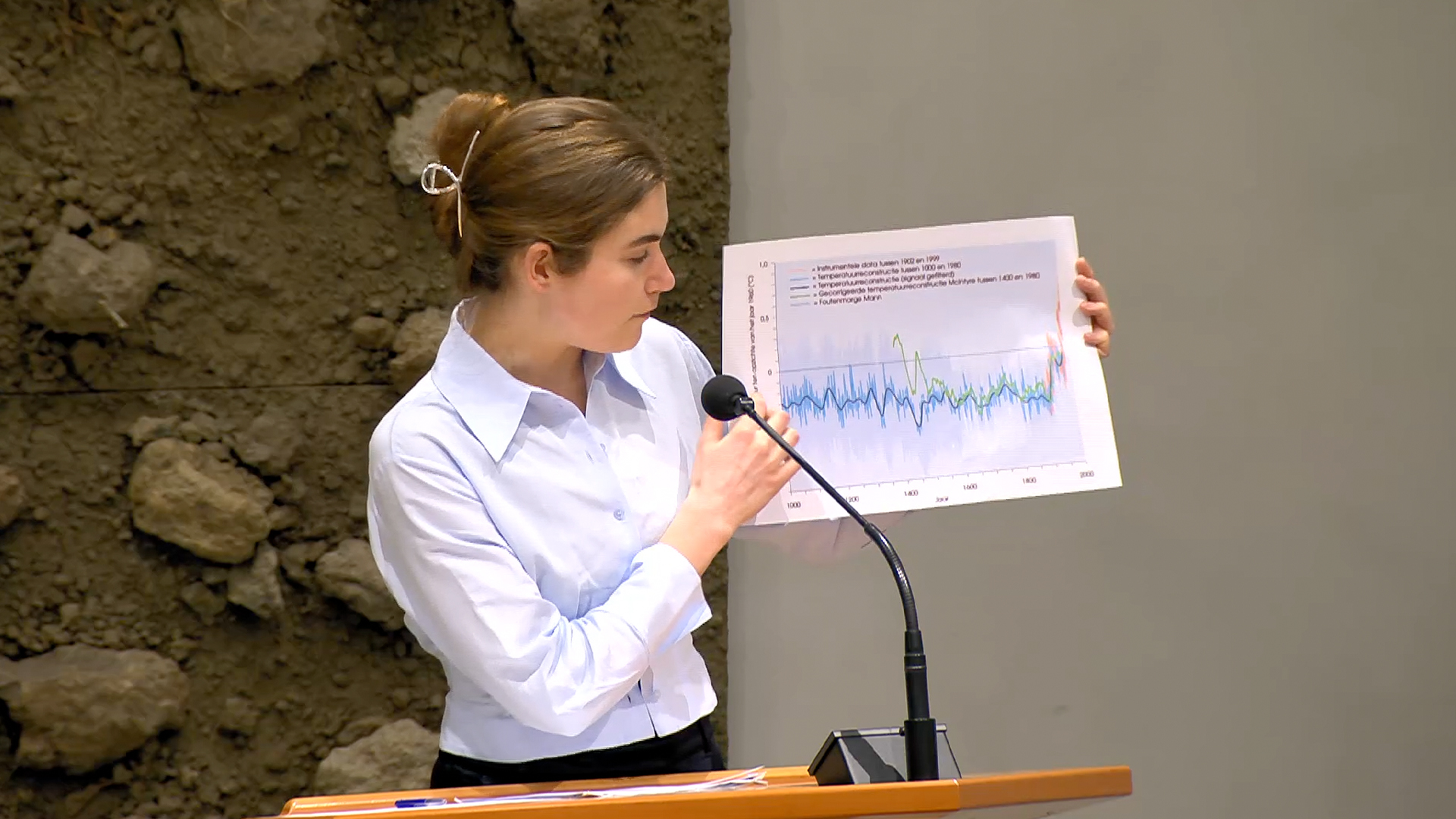
The notorious “hockey stick graph” also played an important role in the climate debate for many years. This graph, presented by the IPCC in the late 1990s, was intended to show that temperatures on Earth had remained virtually stable for centuries before suddenly rising sharply in the past century. This created the impression that current warming is entirely unique in history.
Forum for Democracy has also criticised this in the past. Data series were selectively used, truncated or supplemented with data from other periods, causing natural climate fluctuations largely to disappear from view. Yet climate change has existed throughout all of history. During the Medieval Warm Period, Vikings farmed in Greenland, while several centuries later, during the Little Ice Age, the Netherlands experienced long and severe winters. On even longer timescales, ice ages and warmer periods have alternated repeatedly, something often explained through the theory of Milankovitch cycles. Against that background, the firm claim that current warming is entirely exceptional and caused exclusively by human CO2 emissions is far from uncontested.
The Implications for Climate Policy
Now that even the IPCC is distancing itself from the most extreme scenario of 4 to 6 degrees of warming by 2100, the foundation beneath much of today’s climate policy is collapsing. Why should Dutch or any European citizens continue paying enormous sums for heat pumps, grid expansion, wind turbines, solar fields and expensive climate funds if the underlying disaster scenarios are now being toned down by the climate establishment itself?
Meanwhile, ordinary citizens continue to bear the burden of soaring energy bills and ever-higher taxes, while the Netherlands has barely any influence on total global CO2 emissions. Climate policy is leading primarily to economic damage, loss of purchasing power and the erosion of energy security.
The government should therefore fundamentally reconsider its entire climate agenda, or better yet, scrap it altogether. The billions currently disappearing into climate subsidies, climate funds and unworkable “transitions” could be used far more effectively to lower taxes, make energy affordable again and strengthen the Dutch economy.