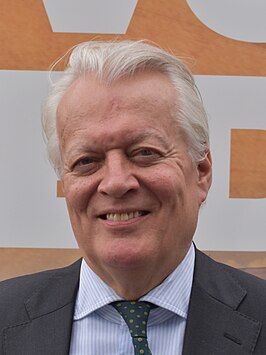
Forum for Democracy Lays Out Its Foreign Policy
30 januari 2026 | Ralf Dekker

Speech by Ralf Dekker MP to the Dutch Parliament, 28 January 2026
Chair,
Over the past five years, our party’s contributions on foreign affairs have always had two central components. On the one hand, firm criticism of supranational structures, the EU and NATO, and their negative impact on our independence and on our ability to do what is necessary for the Netherlands and for the Dutch people. On the other hand, attention to the deeper, often unspoken, causes of conflicts.
We wanted, and still want, to look beyond the reality that is so often presented to the public from a North Atlantic perspective through distorted and censored reporting. This is the imposed “preferred reality”, to use the words of Major-General Van Kappen. This sometimes results in positions which deviate from the mainstream and are not always immediately understood.
But it is precisely through this independent and critical approach that we have also been able, on crucial dossiers, such as Nord Stream 2, to expose geopolitical power games.
In a rapidly changing geopolitical landscape, we as the Netherlands need our own approach and our own vision for the future. On behalf of Forum for Democracy, I would therefore like to propose that the Netherlands formulates a number of clear criteria against which our foreign policy should be tested.
First: the interests of the Netherlands and of the Dutch people are central and are our absolute top priority. First and foremost, we are the Netherlands. Only secondarily are we part of overarching organisations. We must constantly assess whether our national interests are being sufficiently served.
There should be no blind trust, no altruistic behaviour, no automatic adherence to old agreements, and no actions which run counter to our own interests.
Second: strengthening our own economic power, without vulnerable dependencies, in the short and long term.
Third: freedom, peace and security as the basis for our actions. Cooperation and trade are, in principle, not excluded with anyone.
And finally: an open, critical and pluralistic outlook. Things are often not what they seem at first glance.
These four criteria form the compass that guides us through the complex international relations of our time.
Chair,
Europe is in a deep, existential crisis. Not only economically, but also culturally, militarily and not least in the field of freedom of expression. The anchor on which Europe has always slavishly relied, the United States, has cut loose.
The decline of Germany over the past ten years is emblematic of this enormous European decay. Economic growth has more or less come to a standstill; major industries such as BASF, Volkswagen and BMW are languishing. Investment plans do not progress beyond the planning phase. And the energy situation is hopeless. The long-term gas supply contracts of the Netherlands with Germany, at secret, highly favourable rates for Germany, currently constitute Germany’s only affordable energy supply.
And now President Trump is laying all of this bare. In his first term, he proved to be completely right about defence and energy. Now, in his second term, the recent US National Security Strategy effectively defines the EU as a “dying patient” that can no longer look after itself. The criticism of Europe is devastating and amounts to:
- Loss of identity and distinctiveness
- Parasitic behaviour in economic and military terms
- Bureaucratic tyranny: Brussels dictates how we should feel, what we may say, and how we should live
True political leadership would take this harsh American criticism as a wake-up call. But what do we see? Mainly anger. And laughter. The same conceited attitude we saw in 2017 and 2018 when Trump issued his first warning. The traditionally leading countries of Europe and their governments are behaving quite literally like those of Rome during its decline in the fifth century, and like those of the Netherlands in the eighteenth century. Ideology, mixed with arrogant moral self-glorification, is the recipe for the downfall of a society.
The EU has become a kind of ideological fortress that undermines our prosperity, autonomy, security and future growth. A deeply bureaucratic and technocratic institution in which the following are zealously defended: that biological men can become pregnant; that mass non-Western immigration is a blessing; and that “green growth” exists.
But what has the EU contributed to the improvement of the Netherlands over the past twenty years? In that period, we have paid at least €200 billion into it. No more than half of that has come back. The EU gives us the feeling that it has economic value, but in reality it seems mainly to cost us money.
The same applies to NATO, but in the field of security. Certainly, NATO has played a positive role, but from the 1990s onwards its role and significance became unclear. The dominant role of the Soviet Union as the ideological and military enemy of the West, for which NATO was created, disappeared, even though the Ukraine conflict is framed in that way. In the meantime, NATO enriched the US arms industry and made Europe dependent.
We should continuously ask ourselves two questions regarding our bilateral and multilateral partnerships: “What does this concretely deliver for Dutch people?” and “What is the concrete plan and intended outcome for the future of Dutch people?”
Chair, we must be willing to understand that the geopolitical reality has completely changed, at least if we want our country to remain relevant at all.
The new US security strategy focuses on “control” over a defined sphere of influence consisting of South and Central America, Canada, Greenland, Indonesia, Japan, the Philippines, Australia and New Zealand.
That is more than 50 per cent of global GDP and extremely rich in raw materials. The spheres of influence of Russia and China are just as clearly defined. Africa, the central and southern parts, will likely become a battleground for these three blocs, focused on scarce resources. Brazil and India will receive a special status. Ukraine could, in time, become the “Switzerland of Eastern Europe”.
This new geopolitical model no longer revolves around ideology or human rights, which were in fact always selective rhetoric. It revolves around:
- Raw materials, food and water
- Military power and technological leadership
- Big Tech and artificial intelligence
- Control of outer space, connectivity, navigation and satellites
And here, and this is the critical point, North-Western and Central Europe fall outside this new balance and risk becoming the world’s “Orphan Area”, the abandoned region.
This specific European bloc of twenty-five countries, with a combined GDP of approximately 20 trillion dollars, is in poor shape. In addition to enormous cultural and demographic problems, there are major other weaknesses:
-Limited domestic raw materials: strong dependence on others.
-Hardly any indigenous satellite navigation systems.
-Energy weakness: no efficient and future-proof strategy.
-Heavy dependence on China and America: economically, technologically, in AI, Big Tech and pharmaceuticals.
-Industry under severe pressure: competitiveness is eroding rapidly.
-Food production is being dismantled due to climate and nature extremism.
-No vision for 2050 and beyond.
Chair, effective foreign policy is not only about diplomacy. It is primarily about financial power, technological power and military power, linked to relative independence or strong countervailing power in essential products and services.
A forsaken Europe faces crucial choices:
Option 1: Continue on the current path of dismantling, and cultural and economic decline, and merge this into a federal European model. A disaster scenario.
Option 2: Complete vassalage to America — in other words, the erasure of Europe.
Option 3: Autonomous strength and independence, followed by effective cooperation.
Option 3 is the desirable strategy, and it consists of ten essential steps:
Step one: Immediately stop climate policy, green growth and mass non-Western immigration. Start remigration and stimulate autonomous population growth. Reduce central government apparatuses by approximately forty per cent. This will free up a great deal of money for reinvestment.
Step two: Reduce the EU to economic cooperation only. No more ideological or regulatory coercion from Brussels.
Step three: Energy independence through nuclear power and modern fusion energy, and the full restoration of fossil energy.
Step four: Build a fully European satellite system and top-tier rocket technology. Significantly expand and modernise nuclear weapons. Anyone who thinks you have impact without countervailing power lives in a fantasy.
Step five: Industrial and technological revival in every sovereign country. Focus on indigenous Big Tech and AI. We must revitalise our industry.
Step six: Shape the best military industry in the world. In every country a fully capable defence with a “Platinum Dome” per country. Independent capacity to defend oneself and a domestic military industry.
Step seven: Restructure every sovereign country with a focus on better educational outcomes, freedom of expression, pluralistic media, a drastic reduction of rules and regulations, a sound justice system, and the launch of major transformation projects.
Step eight: Mitigate all dependencies. Focus on technological leadership and free trade based on our own and mutual interests.
Step nine: Build superior logistics and food production systems. Food and water are the foundation of geopolitical power.
Step ten: The 1+1=3 cooperation, genuine synergy based on strength, not on the dilution of weakness. Because a bowl of fresh fruit mixed with some rotten fruit quickly becomes entirely rotten.
In other words: Europe, eighty years after the Second World War, once again needs reconstruction. The additional investments required are on the order of €2 trillion per year over the next twenty-five years. That sounds like a lot, but it is less than what we annually waste on bureaucracy, regulation and ideologically driven destruction of value.
It is time for a review of our foreign policy in the broad sense through a “NBT, National Interest Test”.
Foreign Affairs
The Netherlands Court of Audit emphasises that the Foreign Affairs budget contains relatively little policy expenditure, because the majority (90%) is a pass-through for EU-related payments.
The Foreign Affairs budget of €16.65 billion is only a small part of government spending that is in fact connected to geopolitics and foreign policy.
- The Netherlands spends €61 billion per year on international obligations (12.6% of the national budget) and approximately €50 billion on domestic climate, nature, nitrogen and immigration policy.
- Defence/NATO, at €35 billion, is the largest expenditure item (7.2% of the national budget, 2.8% of GDP). With implementation of the 5% norm, this doubles to €62–75 billion.
- EU contributions: €15 billion and rising sharply.
- Climate: structurally €8–10 billion.
- Nitrogen policy: major destruction of value for agriculture and the economy.
- Asylum: €35 billion.
- Guarantees amounting to billions.
Questions to the minister:
- Does the minister also see that, in the national budget, roughly €110 billion is effectively connected to foreign policy?
- And should that entire policy field not be involved in shaping foreign policy?
- How does the minister reconcile the closure of diplomatic posts with the enormous geopolitical challenges facing our country?
- What does the minister think of the idea of a ‘national interest test’ for foreign policy, the same formal check that we run for all other policy areas?
Conclusion:
FVD proposes a course of development based on our own strength and shared interests, not on coercion from Brussels, not on passively awaiting orders from Washington. That is the synergy of realistic sovereignty. Countries that are strong are independent. Countries that are independent can choose. And countries that can choose can cooperate on the basis of what truly matters: mutual interest and mutual respect. This should be the plan for the future.
Forum for Democracy stands ready to shape this foreign policy. Out of love for the Netherlands and for the Dutch people.
Thank you.