From biochemistry and music to politics
10 juni 2026 | Forum for Democracy Intl

Foto: IMAGO / NL Beeld
Dutch young politician de Vos: “I saw my homeland disappearing”
Interview with Lidewij de Vos, Junge Freiheit, 7 June 2026 by Curd-Torsten Weick and Mina Buts.
Like Germany, the Netherlands is also grappling with the consequences of mass migration. In an interview with the JF, 28-year-old FVD parliamentary group leader Lidewij de Vos reveals what kind of political change is needed in Europe.
Dear Ms de Vos, how does a young biochemist and musician end up in politics?
Lidewij de Vos: I sometimes ask myself that too. Science and music are two wonderful subjects, and I could happily have devoted my working life to them, had it not been for the political reality that forced itself upon me: mass immigration, which threatens our security, our welfare and, above all, our homeland; the ever-expanding EU, which is eroding our sovereignty; and ideological fallacies such as the climate and ‘woke’ agendas, which increase the state’s influence over us on a daily basis. I saw my homeland disappearing before my very eyes.
Why did you join the Forum for Democracy (FVD) party specifically, and not Geert Wilders’ PVV?
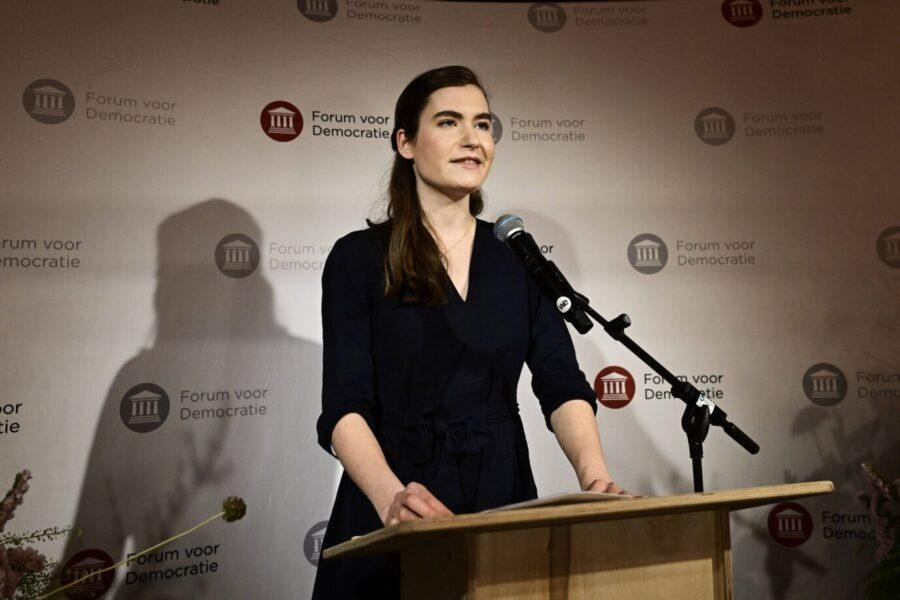
de Vos: From the outset, the PVV was a one-man project led by Geert Wilders, who never intended to build an organisation. Thierry Baudet, however, wanted to do just that. Right from the start, Forum was a movement rather than a party. FVD seeks not only a political but also a cultural shift; one follows from the other. We are not an ‘anti’ party, as the PVV often presents itself, but have a positive vision of the Netherlands which we also want to put into practice.
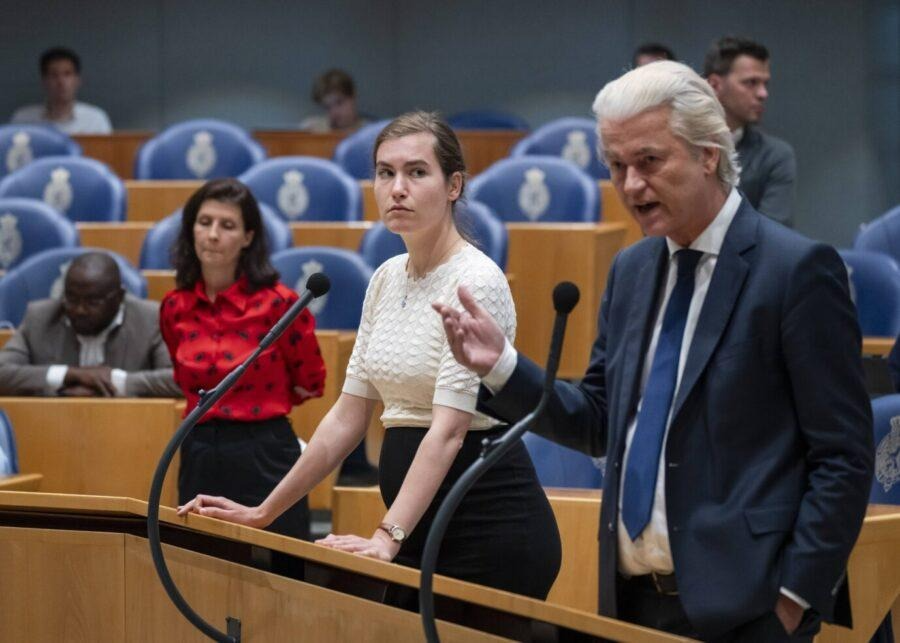
We saw this in the previous cabinet with the PVV: even as the largest party, which also provided the Minister for Migration, there was no noticeable change. The driving forces behind the migration agenda are found right down to the lowest levels in ministries and hidden within countless NGOs and other action groups. If we want to combat them, we need our own people: we must nurture talent, create a network and, above all, establish our own institutions.
What does that mean?
de Vos: We are creating a movement. We organise “Renaissance Academies” for young talent both within and outside politics, we are starting our very first primary school next year, we run a publishing house and many other projects. It may be a long-term process, but it is our only chance.
How do you engage with young people in the Netherlands?
de Vos: Young people are growing up in a system that does not motivate them or encourage them to make the most of themselves. Mediocrity prevails, partly due to the quality of teaching, where the lowest common denominator counts. There is a strong urge among young people to overcome this mediocrity, but they often don’t know how to go about it. The activities of our youth organisation, JFVD, are designed precisely for this purpose. It is exciting to see how young people are striving to surpass themselves.
Whether it is asking a clever question at a reading, presenting a topic to a large group, or testing their mettle in sport and games. It is infectious, motivating and has enormous appeal for young people. Excellence is good, competition is good, but good is not good enough. Those in power only have to manage the status quo; we have to excel in order to eventually overcome them. But in a team of like-minded people, that is also a wonderful task.
In the Dutch local elections in mid-March this year, your party achieved the biggest nationwide increase in support. What were the reasons for this? And what impact is this having?
de Vos: For one thing, the development of our movement is beginning to bear political fruit. Compared to the last elections four years ago, we stood in twice as many municipalities. This is, of course, due to the expansion of our organisation, but also to the promotion of young talent. We have also always told our story: we want local authorities to belong to the citizens once again and we oppose the intake of asylum seekers, which every local authority in the Netherlands is forced to accept under the Distribution Law. Many Dutch people see it exactly the same way, as the elections have shown. We now have 300 local councillors, six times as many as before. Now we can work for four years as the opposition or even in a coalition.
The accommodation of asylum seekers in particular has been a highly contentious issue recently. What is causing the discontent?
de Vos: Just like Germany, we have been grappling for decades with the consequences of mass migration, something the population never agreed to. So far, not a single government has listened to this majority; on the contrary. The Netherlands is setting one immigration record after another. Furthermore, the Distrubution Law was adopted in 2023 by the Rutte IV government, which has since been voted out of office.
With the promise that immigration would decrease, asylum seekers were to be distributed ‘fairly’ across the country. In reality, local authorities were simply forced to take in asylum seekers. The vast majority of Dutch people are against this and want an end to the open-border policy. In recent weeks, the mood has shifted as asylum centres were suddenly announced or set up in numerous municipalities. There have been protests against this across the country.
There were numerous protests by local residents against this, during which, however, dozens of demonstrators were sometimes arrested. What went wrong there?
de Vos: Most of the people protesting were peaceful. I myself was at the protests in Loosdrecht, where the local council is trying to push through an emergency shelter. I met only ordinary Dutch people: parents, grandparents, young women, ordinary folk who are deeply concerned about the problems associated with migration and who do not want to lose their home.
And yet there were arrests?
de Vos: Some protests did indeed get out of hand – I do not want to gloss over that. But I think it is terrible that these incidents are now being used to criminalise the vast majority of peaceful demonstrators who have entirely legitimate concerns about asylum centres. The government is now shirking its responsibility and pretending that the violent protests are the problem. In this way, the public’s fears are dismissed and the government can carry on as before.
Against this backdrop, the Minister for Asylum and Migration, Bart van den Brink, has launched an investigation by the General Intelligence and Security Service (AIVD) to determine whether there is more planning and support behind these disturbances than just concerned citizens who turned up to protest. Who does he have in mind?
de Vos: According to its own statement, the intelligence service is now trying to find out whether ‘far-right’ groups are behind these protests. It is the same old strategy: instead of taking the necessary measures to end mass immigration, citizens with genuine concerns are being pushed into the far-right corner.
The liberal-conservative minority government led by Rob Jetten, comprising the D66, VVD and CDA parties, has been in office since the end of February. What has it achieved so far?
de Vos: Politically speaking: absolutely nothing. Socially speaking, this government has further torn our country apart. During the election campaign, Rob Jetten promised to limit immigration and waved the Dutch flag. That’s why many Dutch people fell for his mainstream party once again. After the elections, he discarded his promises.
This government is managing to shake the last shred of trust the Dutch have in politics. I am therefore all the more pleased that more and more people are finding their way to us. Our membership is growing, we were successful in the local council and parliamentary elections, and we are rising in the polls. The mass protests against the asylum centres also show that the government’s half-life has already passed. We need an alternative.