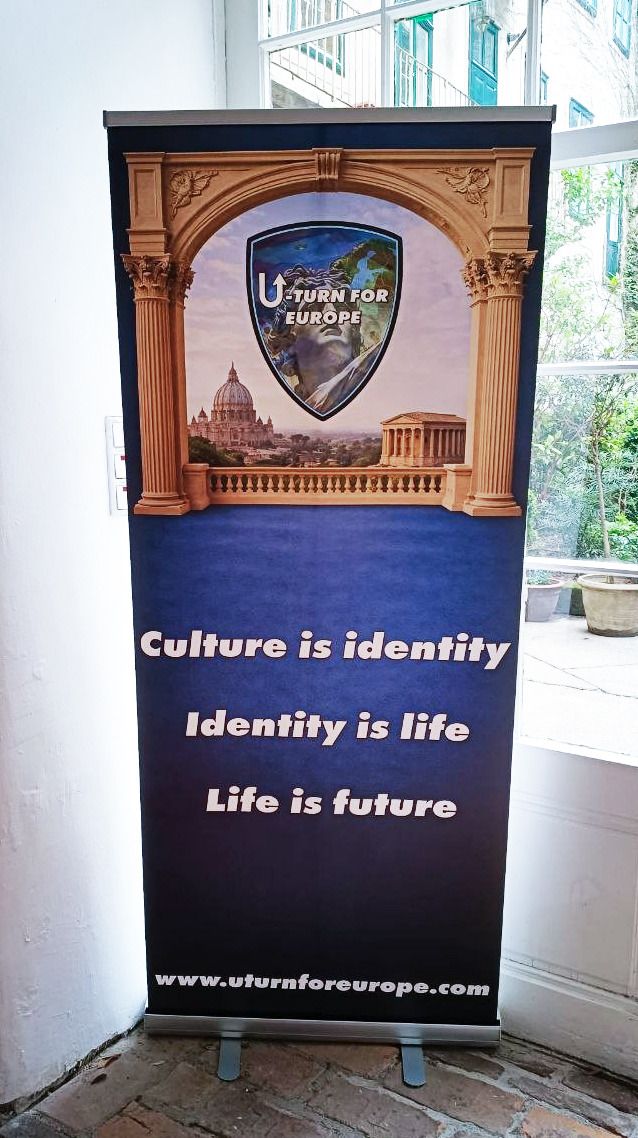
How to make a U-Turn for Europe
07 mei 2026 | Stefan Korte

At the first international values conference of “U-Turn for Europe”, held in Vienna in April, it became clear that the erosion of values has long since spread across the whole of Europe. Culture, education, law, finance, the economy and the media all show signs of erosion which are not coincidental but instead structurally driven. They are the expression of a deeper underlying problem: the loss of a shared frame of reference, in other words of our cultural roots.
This development is particularly evident in politics. Decisions are primarily guided by short-term pressures, media impact and tactical considerations, while responsibility, moderation and cultural grounding are losing importance. However, one must not fall into the misconception that politics is the cause of the decline in values. It is both an instrument and a reflection of it.
Politics is only as good as its protagonists. When a society erodes, moral principles also disintegrate. Values which sustain a coexistence shaped by respect and honesty are among the first to be lost in a process of societal decline. In this way, a society develops whose primary goal is to place the ego above all else, subordinating the common good to it.
Even those who claim to oppose this process are part of the same society and are subject to its influences. This is precisely where the problem lies: the aspiration for change too often runs into patterns of behaviour which themselves reflect the very developments being criticised. This is particularly evident in politics, where idealism gives way to party-political pragmatism. In everyday political life, too little effort is devoted to strengthening a worldview which could serve as a foundation for political and cultural action. Election manifestos alone are not enough. In order not only to win elections but also to bring about real change, political thinking must be more deeply rooted in the everyday cultural life of the people.
It is precisely at this point that a new form of engagement must emerge—not focused on how individual political measures can be adjusted, but on the fundamental question of the cultural, moral, and strategic foundations on which Europe can endure.
The conference addressed topics ranging from cultural identity and social cohesion to questions of sovereignty and geopolitics, as well as media, narratives and the role of new technologies in shaping reality.
This breadth of content was also reflected in the participants who came from numerous European countries and underscored the nature of this development.
The conference was opened by the project’s patron, Prince Leo von Hohenberg, who emphasised in his speech the fundamental importance of the values that have shaped Europe over generations. Europe, his central message, does not live solely from institutions or political constructs, but from a cultural and historical continuity that creates identity and provides orientation. It is precisely from this heritage that a special responsibility for the future of the continent arises.
Thierry Baudet, founder and president of the Dutch political party, Forum for Democracy, insisted on the importance of meta-political activities – cultural, certainly, but also financial and social - and on the key importance of involving young people in the project of renewal.
A security policy perspective was provided by the former Commander-in-Chief of the Lithuanian Armed Forces, Valdas Tutkus. He demonstrated that the loss of values is by no means an abstract problem but that it has direct consequences for the stability of states. Where moderation, a sense of duty and responsibility erode, structural weaknesses emerge which have particularly serious effects in areas relevant to security.
The political scientist John Laughland directed attention to the intellectual-historical dimension of the development. A society which is based solely on self-interest and which abandons binding moral standards risks sliding into a form of nihilism. The resulting void fosters ideology, propaganda and social upheaval.
These central contributions were complemented by a wide range of other speakers from across Europe, who brought different national experiences and perspectives. From questions of cultural identity and education to developments in the legal system and the economy, as well as geopolitical shifts and the effects of migration and social change, a multifaceted overall picture emerged. Despite all differences in historical background and political starting points, a clear common denominator became apparent: the ongoing loss of binding standards and the increasing decoupling of political and societal developments from their cultural foundations.
It was precisely this diversity of nations and perspectives that made clear that Europe is not facing a sum of individual crises but a fundamental challenge which affects the continent at its core.
Against this backdrop, the values conference does not see itself as an isolated event, but as the starting point of a long-term process. What began in Vienna is to be translated into concrete measures in the coming months.
At the centre of this effort is the establishment of a viable European structure. With the founding of the support association, an organisational foundation has already been created, which is now being systematically expanded. The aim is to establish a robust network of committed participants working across national borders and further developing a shared line of thought.
A key next step will be to consolidate the results of the conference and record them in a joint declaration as a working basis for further cooperation. Building on this, an operational group will translate the developed approaches into concrete projects and continuously refine them.
At the same time, we aim to significantly expand our European presence. In several countries, additional structures are already in preparation which will broaden the project’s base and enable closer cooperation between participating nations.
In terms of content, the work will not be limited to analysis. Rather, the goal is to systematically address cultural, societal and political issues and to develop viable approaches for long-term renewal. This includes the establishment of a think-tank as well as publications, workshops and formats designed in particular to involve young people more closely and to raise awareness of issues of identity, culture and responsibility.
This makes one thing clear: the real challenge no longer lies in describing the problems, it lies in putting solutions into practice.
Europe will change. The decisive question is whether this change will be consciously shaped or result from the dynamics of existing negative developments.
In this context, U-Turn for Europe sees itself as a platform for those who are willing to take responsibility and actively shape this process.