Lidewij de Vos in Conversation with Wouter Koolmees about Government Formation
13 november 2025 | Lidewij de Vos
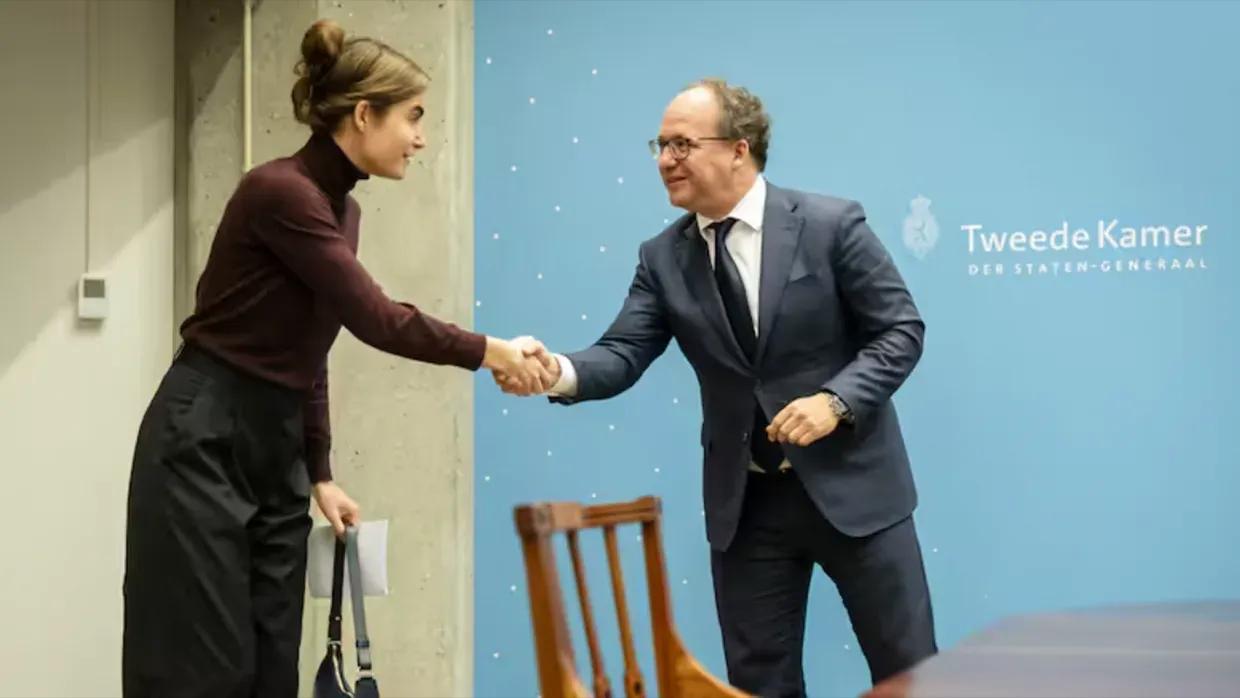
Lidewij de Vos paid a visit to “informateur" (someone who explores the possibilities for a new government) Wouter Koolmees. In the run-up to the coalition talks, De Vos presented an alternative to the usual process of backroom politics, in which parties trade positions among themselves. According to the Forum for Democracy (FVD) parliamentary leader, government plans should be shaped on the basis of shifting majorities in Parliament. Through votes, the House of Representatives should outline the main directions for the next four years, the implementation of these directions should then be carried out by ministers.
In a letter to the informer, De Vos explains how she envisions this process. The letter is reproduced below.
Dear Mr Koolmees,
The Netherlands was built by generations who dared to dream and had the courage to make those dreams come true. From the fight against the sea in the Golden Age to the reconstruction after 1945, from the Delta Works to the knowledge economy, time and again the Dutch have shown that the impossible becomes possible when we dare, cooperate and look ahead.
Continuing that tradition is the fundamental task of every government. Not merely managing what exists, but building what is yet to come. Not passing today’s problems on to tomorrow, but solving them with vision and determination. Not keeping the Netherlands small out of fear, but making it great with ambition.
With this letter, Forum for Democracy wishes to make a constructive contribution to the formation of a government that will enable the Netherlands to grow again, a government in which all Dutch people who wish to contribute are heard, and in which we work together to build a country we can be proud of.
Problem analysis: thirty years of stagnation under “stable governance”
Over the past 35 years, the Netherlands has enjoyed a level of political stability rarely seen. Lubbers for 12 years, Kok for 8, Balkenende for 8, Rutte for 14, all examples of the much-praised stability. Yet we must ask ourselves: what has all that stability brought us?
The honest answer is painful: the Netherlands has not progressed, but regressed. Under the banner of stable governance, fundamental neglect has piled up.
No major projects have been realised that structurally improve our country, no new Delta Works, no visionary infrastructure, no investments that help future generations. We have stopped building and started merely managing. There is no long-term plan for the development of the Netherlands over the next 25 to 50 years. Every government looks four years ahead, not a generation. We drift rather than set a course.
Our once perfect energy system has been replaced by unreliable “wobbly energy”, while we halted our own natural gas extraction. We have made ourselves vulnerable and dependent, when we could have been energy-independent.
Uncontrolled non-Western mass immigration now costs our country a net €25 billion per year, while integration fails and parallel societies emerge. Social cohesion has vanished, polarisation reigns, Dutch citizens no longer recognise their own streets and neighbourhoods.
Education, healthcare and police services are struggling with shortages that were foreseen 15 years ago. There is a housing shortage of 400,000 homes, which we created ourselves by admitting millions of people while failing to build. The performance of our education system continues to decline in international rankings. The disposable income of an average household has fallen by about 40 per cent compared with 1995. People work harder yet do not move forward. The promise of prosperity has been broken.
Stifling regulation, partly self-imposed, partly dictated by Brussels, has paralysed the country. Farmers can no longer farm, builders can no longer build, entrepreneurs drown in paperwork. The Netherlands has largely transferred its sovereignty to the EU. The impartiality of our legal system and the pluralism of our media are under pressure.
This is the harsh truth: so-called “stable governance” has brought the Netherlands and its citizens very little good over the past 35 years. Stability can also mean stagnation, and stagnation is decline in a world that keeps moving.
Short-term task: immediate relief for the Dutch people
The new government must show, from day one, that politics makes a difference in people’s daily lives, not in four years, but within six months.
An end to mass immigration as the first priority. A direct asylum stop, expansion of existing remigration legislation, and the restoration of Dutch control over our borders are crucial to restoring calm and cohesion in society. Labour migration should only be permitted where genuinely needed and with high quality standards.
Restoring our prosperity. Dutch families must experience a tangible improvement in purchasing power. That means: drastic tax cuts for workers, lower energy costs, affordable groceries, financed from the tens of billions currently spent annually on migration and climate policies. Concretely, this means at least €400 net more per month for average households.
Solving the housing shortage. By cutting through bureaucracy, promoting remigration and investing in rooftop extensions and property divisions, we must free up 100,000 housing spaces per year. Young people should again be able to live independently from the age of 22, and families should have room to grow.
Restoring our energy independence. The Groningen gas fields should be reopened for Dutch use, we must invest in nuclear energy and stop the “wobbly energy” that makes us dependent and poorer. Groningen must be fully compensated and made earthquake-proof. This will immediately lead to lower energy bills and strategic security.
And finally, deregulation. We will impose a maximum processing time of six months for all permits. We will halt the nitrogen policy that is destroying our world-class farmers based on dubious models. We will let entrepreneurs do business again.
The billions saved will be invested in Dutch families, education and healthcare. These measures will give people breathing space, restore confidence, and demonstrate that the Netherlands can once again be a country where hard work is rewarded.
Long-term focus: the Netherlands of 2050
But a government that only extinguishes fires does not build a future. The Netherlands needs an ambitious long-term vision to once again make our country a world leader. We must start building grand projects as our forefathers did.
Schiphol at sea: an artificial island off the coast of IJmuiden capable of handling 100 million passengers and freeing up 2,700 hectares in the Randstad for housing and nature.
A hyperloop network connecting all of the Netherlands within 15 minutes, linking regions and cities efficiently.
New Maasvlakte extensions for our port and energy projects.
These are not fantasies but achievable projects that create employment, prosperity and pride. We must invest in sectors where we are global leaders: ASML and the semiconductor industry, agri-tech and precision farming, maritime innovation, and cybersecurity.
We must also build a strong, specialised defence industry by allocating part of the defence budget for that purpose. We must reform our education system so that we once again train top talent in the fields that make the Netherlands strong: technology, the sciences, healthcare, and education itself.
Focus on excellence and practical ability. We must restore the soul of the Netherlands: respect for those who work and create, care for one another in communities, pride in our identity and achievements, and freedom to speak one’s mind. Not through preaching but through action, by granting freedom, restoring trust, and building a society people want to belong to.
This Netherlands, prosperous, safe, free, innovative, proud, is within reach within 25 years.
New cabinet: broad support and true representation
These great tasks, immediate relief and long-term vision, require a government that represents the Netherlands, not just The Hague. That means all parts of society must see themselves reflected in the cabinet: working people, entrepreneurs, farmers, healthcare workers, technicians, students and teachers. Not only administrators and political professionals, but people with practical experience who know how the Netherlands really works.
It also means that citizens must be able to have their say on major policies through binding referendums. Direct democracy strengthens the bond between citizens and government.
Our preference is for an approach in which the House of Representatives first votes freely on various themes, after which specialist ministers are appointed to implement those decisions. Topics on which majorities already exist, such as restricting immigration, introducing a binding referendum, and starting the construction of new nuclear power stations, can thus finally be acted upon. In this way, we break the deadlock of a sealed coalition agreement and promote dynamic, democratic decision-making that reflects the will of the people.
Concretely, this would mean starting with a series of general votes in the House to determine on which issues majorities currently exist. For example, on the “right”: restricting asylum and migration law, investing in nuclear energy, reducing regulatory burdens, maintaining mortgage interest relief. But also, on the “left”: democratic reform, improving education, introducing binding referendums, phasing the healthcare deductible.
The House could then elect a Prime Minister from among its own members, similar to how the Speaker of the House is currently chosen. This Prime Minister could appoint ministers in consultation with the parties that, depending on the portfolio, belong to the “majority” that emerged during the votes.
A Minister of Finance, directly accountable to the Prime Minister, would act as coordinator. Meanwhile, the House could exercise control over policy, adjust where necessary, and, if needed, call a referendum.
Only with such a broadly supported cabinet will social cohesion return. Only then can we overcome polarisation and build together. Only then will we regain the trust necessary for great change.
Conclusion
Forum for Democracy wishes to make a constructive contribution to this process.
We are prepared to take on government responsibility, not out of self-interest, but because the Netherlands needs this change of course.
We bring concrete, achievable plans. We bring connection with millions of Dutch citizens who feel unheard. And we have the courage to take bold decisions. The Netherlands does not need another four years of drift, but a government that builds and looks ahead, that dares, that leads. A government that continues the legacy of generations of Dutch who made the impossible possible.
Let us build together a Netherlands where everyone who wants to contribute, counts.
A Netherlands that grows again. A Netherlands we can be proud of.
A Netherlands for our children.
With kind regards and a willingness for constructive dialogue,
Lidewij de Vos
Parliamentary Leader, Forum for Democracy
Member of the House of Representatives of the States General