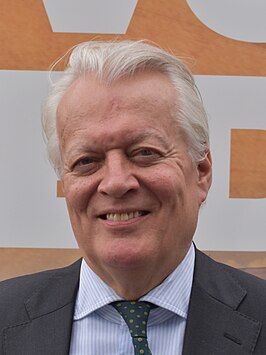
Ralf Dekker on the Middle East
24 april 2026 | Ralf Dekker

Speech to the Second Chamber of the Netherlands States-General (Parliament)
16 April 2026
For a long time, I was under the impression that the instability in the Middle East, unfavourable to the Netherlands in many respects, was ultimately caused by autocratic, predominantly Islamic states.
At the centre of this stood Israel, as a democratic oasis and the only foothold of the modern West, bravely resisting an irrational and aggressive environment with the support of the United States and the rest of the Western world.
It was therefore our sacred duty, so I believed, to support and protect Israel. Also to ultimately prevent ourselves from being overrun by Islamic migrants with the same unfounded hatred. This is what I was brought up to believe.
But, Madam Speaker, this worldview has gradually shifted.
The events of 7 October 2023, when Palestinians from Gaza breached the border with Israel undetected and spread death and destruction, were shocking.
However, they appeared to be used as justification for unprecedented large-scale Israeli brutality and destruction in Gaza, resulting in tens of thousands of civilian casualties and the total devastation of civilian infrastructure, whereas this shocking event could also have marked the beginning of genuine, fundamental discussions.
The initial sympathy for Israel as a victim on 7 October has worldwide turned into shock and anger at the scale of what the Israelis were doing.
The situation in Lebanon today unfortunately bears strong similarities. Here too, there is unprecedented brutal destruction of civilian targets, allegedly because they are Hezbollah hideouts. Even inhumane white phosphorus weapons are being used.
And then Iran. This country has long been sanctioned, boycotted and opposed by the West in every conceivable way. The main reason given is that Iran is supposedly on the verge of developing a nuclear weapon.
That would also pose a threat to the Netherlands.
But this claim, that an Iranian nuclear bomb is only weeks away, has existed since the 1990s. It has been consistently denied by Iran, with the principal ideological opponent of such a bomb being the Supreme Leader Khamenei himself.
He was, notably, one of the first to be deliberately targeted and killed by Israel in the war.
Moreover, the nuclear site was reportedly successfully “obliterated” in 2025, according to the Americans. Senior American officials such as Tulsi Gabbard and Joe Kent have also stated that there is no evidence of an Iranian military nuclear programme.
Does the minister nevertheless believe that Iran poses a nuclear threat to the Netherlands?
Or are the United States, and we in their wake, being drawn into serving Israel’s agenda?
The statement by the Minister of Foreign Affairs, Marco Rubio, that the Israeli attack on Iran was the trigger for American action, illustrates this.
The ultimate objective appears to be, as has happened with countries such as Syria and Iraq, to eliminate and destroy a potential regional adversary of Israel.
The principle of “the right to strike first and then call it self-defence” has become an Israeli/American hallmark: the pre-emptive strike.
A simpler term for this behaviour is “aggression”.
It strongly appears that Israel, at least the Netanyahu government, is not seeking peace in the region, but domination.
The dream of “Greater Israel”, from the Nile to the Euphrates.
We are now convinced that the threat Israel feels is largely the result of its own actions, with the United States following in its wake.
The Netherlands must not support the current American/Israeli policy of violence, intimidation and bad-faith negotiations.
Iran does not pose a threat to the Netherlands.
The path to peace in the Middle East, and thereby to stability in the Dutch national interest, must run through diplomacy.
A radical change and limitation of Israeli ambitions and approach are essential for this, alongside a fully-fledged two-state solution.
The current explosive stalemate, from which neither party can escape, offers a unique opportunity for radical solutions.