Youth crime and migrant backgrounds: figures The Hague would rather avoid
27 mei 2026 | Forum for Democracy Intl

The Netherlands has a growing problem with youth crime. Not only on the streets, but also in the classroom, on social media and in statistics. Young people are increasingly suspected of weapons offences, schools are suspending more pupils over weapons, and the police are seizing knives and firearms from minors with increasing frequency. According to RTL Nieuws, the number of minors suspected of weapons offences rose to a record high last year. The number of school suspensions over weapons also reached its highest level in years.
At the same time, research into youth crime has for years revealed an uncomfortable reality: young people from migrant backgrounds are over-represented in crime statistics in virtually all European countries. This also applies to the Netherlands. The study ‘Youth Crime among Migrants’ by the Knowledge Platform for Integration & Society explicitly states that young people with a migrant background feature more frequently in statistics on youth crime. Furthermore, clear differences are visible between different ethnic groups.
Young offenders and migrant backgrounds
The study shows that young migrants in Europe are more frequently involved in offences than young people without a migrant background. It is striking that this is not limited to minor offences. Young migrants score higher across various types of offences, ranging from vandalism to extortion, from street robberies to serious violence.
Differences also exist within migrant groups. In the Netherlands, young people of Turkish origin appear to be more frequently involved in violent offences. Young people of Moroccan origin, on the other hand, are more frequently involved in property offences. Furthermore, the study identifies Moroccan-Dutch and Antillean-Dutch young people as groups that have long been overrepresented in crime statistics and in youth detention centres.
Moreover, the figures are substantial. Within the international ISRD-2 study, in which over 68,000 young people from 30 countries took part, nearly one in four young people had a migrant background. In the Dutch study group, that proportion stood at 35 per cent, of whom more than three-quarters belonged to the second generation. More importantly, the study shows that first- and second-generation migrant youths are more likely to report offences themselves than youths without a migrant background. Among the first generation, 40 per cent reported having committed a crime at some point; among the second generation, this figure was 42 per cent, compared with 34 per cent among young people without a migrant background. This over-representation applied to both minor and more serious offences, and to both violent and property offences.
These figures call for honesty. Anyone who wants to tackle youth crime seriously must dare to identify where the problems are concentrated. Looking the other way helps no one. Not the victims. Not the neighbourhoods. Not the schools. And not the young people themselves either.
Migrant groups as a whole
Moreover, this over-representation is not limited to youth crime. We see similar patterns among adults too, including in relation to sexual offences. Statistics Netherlands (CBS) data shows that men from various non-Western migrant groups are suspected of sexual offences significantly more often than native Dutch men. Among men of Somali origin, the number of suspects in sexual offences was even more than twenty times (!) higher than among native Dutch men. The figures were also significantly higher among Afghan, Iraqi, Eritrean, Iranian and Syrian men.
Furthermore, earlier CBS figures show that non-Western men aged between 12 and 45 are systematically more likely to be suspects in sexual offences than native Dutch men. For some groups, this over-representation was several times higher. Men with backgrounds from the former Netherlands Antilles, Morocco and Suriname featured particularly frequently in these figures. According to researcher Jan van de Beek, these differences are particularly relevant because many migrants eventually obtain Dutch nationality, meaning that figures based purely on nationality may ultimately give a distorted picture.
Text continues below the image
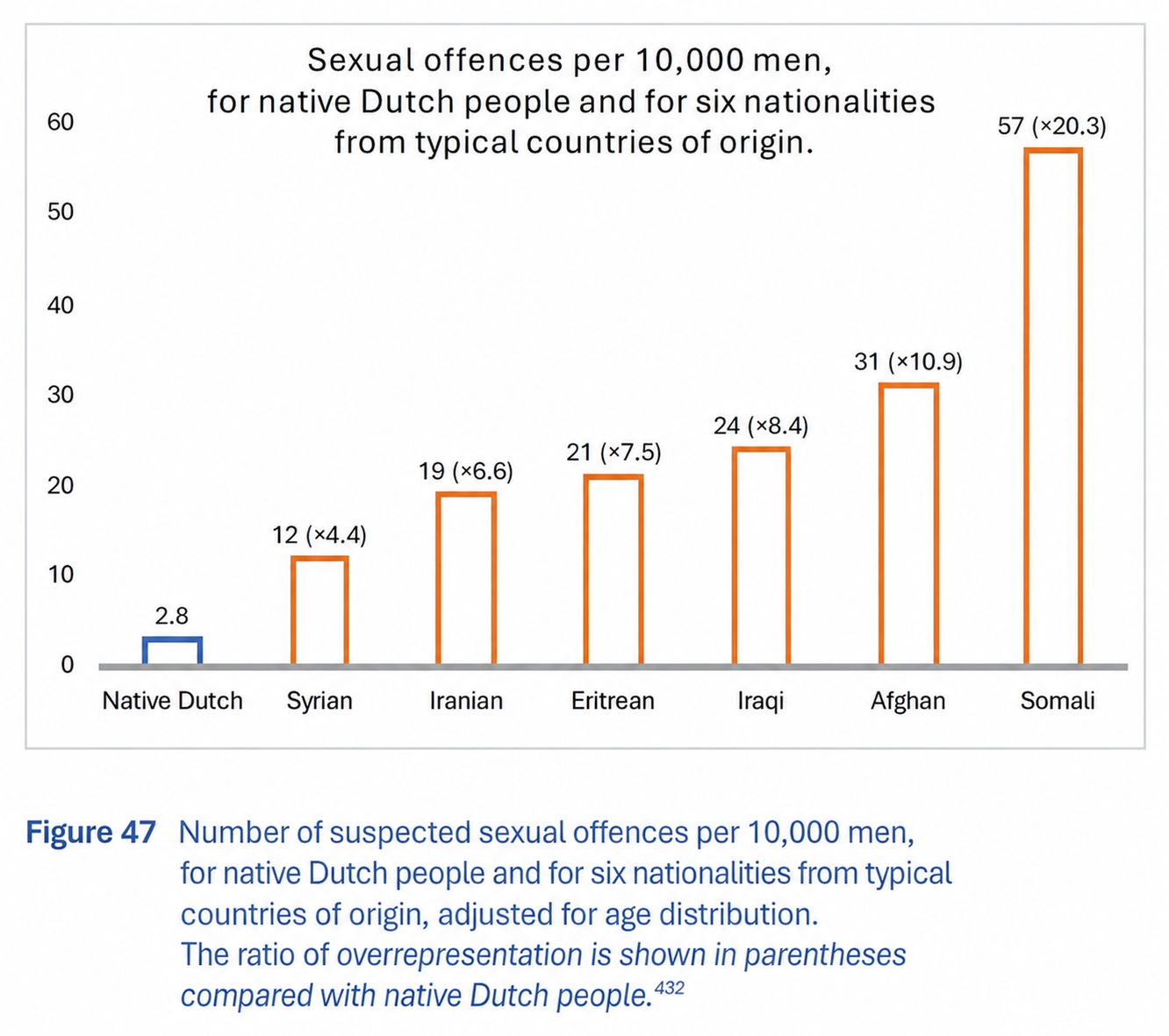
Figures from Jan van de Beek show the significant over-representation of migrant groups in crime
These figures show that the problem extends beyond youth crime alone. Among adults too, there are clear differences in crime rates between population groups. This calls for an honest debate and policies that do not turn a blind eye to uncomfortable statistics.
The streets are getting tougher
Concerns are particularly high due to the rise in gun ownership among young people. According to RTL Nieuws, the figures on gun ownership and gun use are “alarming”. The police have seized a record number of illegal weapons from minors. These are mainly knives, but increasingly also firearms, including converted gas pistols. According to a police firearms expert, these weapons are traded via social media, among other channels, where young people can obtain them anonymously.
Such violence is no longer confined to street brawls. Young people are increasingly being recruited into criminal networks and gangs. The situation is spiralling completely out of control, particularly in countries such as Sweden. There, authorities have been grappling for years with explosions, contract killings and young gang members. According to the Swedish government, increasingly younger boys are being recruited because they are easily influenced and, until now, could hardly be prosecuted
The Swedish approach
Sweden is therefore lowering the age of criminal responsibility to 13 this summer. A child found guilty of murder could soon face up to two years in prison, and a 14-year-old even up to four years.
The country is now building special youth prisons to house underage gang members. In Rosersberg, north of Stockholm, entire wings are being fitted out for young offenders aged 13 and 14. According to the Swedish government, the situation has become so serious that tough action is necessary.
The Swedish approach shows how quickly youth crime can escalate when the government has been too lenient for years. What begins with street terror and gun ownership ultimately ends in gang wars and child soldiers.
Campaigns do not work
The Dutch government has been responding for years with campaigns, posters, weapon surrender schemes and well-intentioned slogans. But the results are shockingly poor. The 2020 ‘Weapons and Young People’ action plan aimed to reduce the number of weapon-related incidents by a quarter within two years. The opposite has happened: since 2019, figures for gun-related crimes have not fallen, but risen. The number of under-18 suspects in gun-related crimes increased by 20 per cent.
Experts are harsh in their judgement. The policy has failed. According to Ferwerda, the target group laughs at adverts and posters. Researcher Frank Weerman also warns that general public information campaigns and gun-in-exchange schemes have little effect and may even increase the sense of insecurity.
Stop looking the other way
Forum for Democracy believes that safety begins with acknowledging reality. If certain groups of young people are systematically over-represented in crime statistics, then politicians must address this. Only by facing the facts can we protect the safety of the Dutch people.
That means taking a tough stance on youth gangs, weapons and repeat criminal behaviour. It also means that the police, the judiciary and local authorities must no longer pretend that general campaigns are sufficient. The figures show that this approach does not work.
Dutch people have a right to safe streets, safe schools and safe neighbourhoods. Parents must be able to send their children to school without fear. Young people must be protected from criminal groups that normalise weapons. And offenders must realise that crime has consequences.
FVD’s plans for a safer Netherlands:
- Always enough prison places: We will expand prisons so that there are always enough cells and sentences can be served in full. We will expand prisons so that there are always enough cells and sentences can be served in full.
- Harsher sentences: Fewer community service orders, more prison sentences. Harsher sentences for serious violent and sexual offences, and locking up repeat offenders sooner, so that criminals know that crime really does have consequences.
- Revocation of citizenship and deportation of criminals: We will revoke the citizenship of dual passport holders who commit serious crimes and immediately deport criminal asylum seekers, so that the Netherlands becomes safer.
- Profiling in investigations: We will allow the police to profile on the basis of statistically relevant categories, so that investigations proceed more quickly and effectively.
- Deporting the families of criminal asylum seekers: We will hold the parents of criminal asylum seekers liable for their children’s misconduct and, where appropriate, terminate their asylum procedures as well, so that they themselves take corrective action.
Do you appreciate what we do? Then please consider making a donation to support our work! You can do so by clicking here.